

How To Clean And Seal Small Cones For Jewelry
Nancy LT Hamilton
Last updated: x/12/21, 7/31/20, 7/28/20, vii/v/19/20, 5/13/20, 11/17/18
Please see my Disclaimer Page.
Contents
- one Finishing 925 silver (sterling silvery), tarnish, polishing
- 2 Studio Cleanup – How to vacuum and make clean up the grit created while finishing jewelry
- 3 Removing Firescale and Oxidation
- iv Protecting Sterling Silverish from Oxidation
- 5 How to Finish and shine bronze
- half-dozen How to cease copper, as well every bit brass jewelry
- 7 How Practice I Take Off Scratches From Copper Earrings Using Different Sanding Grits?
- 8 How do you finish gold?
- 9 Protecting the terminate on metals
- 10 Can the rouge I use for buffing gold be bad?
- 11 What chemical compound should I buy for 22k gilt polishing
- 12 How To Make clean And Smoothen In Tight Spots
- 13 How To Protect A Cease And Go along The Coating From Bottleneck Holes
- fourteen What compounds should I use?
- fifteen How to end edges and interior pierced areas.
- 15.one Making a Sanding Stick
- xv.1.1 Sanding stick with foam
- 15.i.2 Sanding stick without foam
- 15.one Making a Sanding Stick
- xvi Is Information technology Ok To Rub A Green-Scrungy-Thingy On 14k Gold-Filled Canvas Metallic To Get A Brushed Stop Or To Fine Steel Wool It?
- 17 How do you lot put a scratched ("water ice") finish on metal jewelry?
- 18 Tin I Silver Plate Nickel?
- 18.1 How Do I Texture My Metal To Match This Pattern (Looks Like Reticulation or A Sandpaper Finish)
- nineteen How to Create a White, Matte, or Satin ("Ice") Finish on Silver
- 20 More than Data
- 20.1 Related Videos
- twenty.2 Related Web Pages
Finishing 925 silver (sterling silvery), tarnish, polishing
Question
"I'1000 glad that I found your video clip on youtube and then your blog and last your Facebook so I can take a conversation with you.
I am new to making jewelry, and I currently piece of work on oxidized silver. Withal, I don't know the process for 925 silverish products to finish polishing. Practise u think I need to do some coating/plating before oxidized?
And more of import is which brush is ok for cleaning the night out on some surfaces and all the same keep some areas dark.
In one case I tried just, it turned out that I over-polished it. It turned to the colour of 925 silver, then iii-5 days later on the silvery turned yellow. I was really sad about that.
Wonder how some brands similar Trollbeads can change the beads to Non 925 original silver colour.
Delight help, I stuck stuck stuck here"
Respond
Lots of questions. Big questions. On finishing your silver, information technology all depends on the blazon of finish you want and how much finishing your metal needs. I accept a few videos on finishing, sanding, etc. on my finishing playlist on YouTube. Please see this link to More than Information, on this page.

Stainless Steel Polishing Medium
If in that location are no scratches on the metal and cipher to make clean up, like solder blobs, and you desire a shiny finish, tumbling with stainless steel shot is the easy fashion to go. Other methods for achieving a mirror finish involve sanding and and so polishing. It's a huge subject with tons of techniques and a myriad of tools involved. Not accountable here.
Darkening the metallic is not usually washed until afterwards finishing. Then information technology needs to accept the highlights added by removing the nighttime color from areas that you don't desire it to be. In that location are products that can remove tarnish like pro polish pads, #0000 steel wool, silver polishes, silver cloths, etc.

Anti-Tarnish Tabs
If you want to go on your silver from darkening over fourth dimension, use either an anti-tarnish handbag, tab , or strip . You can put the tabs or strips into plastic bags for storage, to proceed the tarnish from happening in the start place.
Y'all can't "over polish" – unless that means you polished then much that the argent was worn away! Is the metal you are working with silverplate? If you smooth that besides much, you can remove the plating, and if they used brass or bronze, every bit the base metal, over finishing can remove the silver coating – exposing the yellow below. I accept never polished something and had it turn xanthous.
Sometimes, silvery volition start to turn xanthous earlier it fully tarnishes. Perhaps that is what'due south happening?
Do you live in a identify where there is a lot of pollution? Pollution can sometimes cause more than rapid tarnishing. FYI, 925 silver is also chosen sterling silvery. Both fine silverish and sterling are silver-colored. Although sterling tin be a little grayer than fine silvery, nigh people can't run across the colour difference.
Perhaps you lot didn't rinse the piece well after applying the patina. Silver turns yellow if it is placed in the liver of sulfur for only a brusque period of time or it can yellow if the patina has not been neutralized properly. This ring of mine was only in the liver for a few seconds and it looks similar gold, as a outcome! The patina didn't final long as I didn't seal it and rings undergo a lot of vesture and tear – causing the patina to wear off.

Studio Cleanup – How to vacuum and clean up the dust created while finishing jewelry
Question
How practise you lot clean up your studio after filing or sanding with the Dremel or Flex Shaft? Do you use a regular vacuum cleaner? If and then, tin can this vacuum exist used for the home? Will the particulates pass through the vacuum'due south filters and contaminate our air?
Answer
My first step is to apply a whisk broom to clean upward surface messes – wearing an N95 particulate mask!
Yous might also recall about getting a modest shop vac for when you are sanding or finishing. Ready up some kind of drove hood. That manner you don't have a big cleanup. Warning: they are loud!
Sometimes, if I've been dropping many things on the floor, I put a nylon stocking, with an elastic band around it, over the end of my hose. This lets me catch anything I may have "lost" on my flooring.
I assume that y'all are wearing an N95 particulate mask while sweeping and vacuuming?
I do have a studio-dedicated, small vacuum. Information technology has a ton of attachments to get into all the nooks and crannies AND (this is a big one!) it'south got neat suction! I don't recommend using the aforementioned vacuum in your studio as yous exercise in your habitation.
Now, I take an under-bench vacuum that hooks to the base of my bench pin. The vacuum collects all the metal dust and I just send in the filters for refining, when they are set for replacement. Rio Grande, Otto Frei, Stuller, and other companies carry a diversity of grit drove systems for a wide variety of prices.

Knew Concepts Face Shield
I also accept a Knew Concepts Face Shield to help go along the dust out of my face.
Removing Firescale and Oxidation
Question
Yous country you: exit too many "fire marks" – what practice you mean by that? Are you using pickle to clean the metal after soldering? Or are you seeing that grey bruising after polishing (firescale)? If you are seeing firescale, try doing something similar what is in thisRio Grande article. If you lot have oxidation from soldering, attempt a nickel pickle: Here's one article fromHoover and Strong.
Answer
For getting into all the nooks and crannies, try the3m Radial Bristle Discs. They work great! To learn more about finishing please view my webpage:Finishing Jewelryand my video:How To Finish Jewelry.
Protecting Sterling Silver from Oxidation
Question
"Should I be finishing the metal (sterling silver) to prevent farther discoloration? What'southward the best mode to practice that? Exercise y'all have any videos that address that question?"
Answer
The oxidation is non going to terminate unless the metallic is sealed – which I don't recommend. Although it is fine for necklaces and brooches, sealers wear off very quickly on bracelets and rings – due to the amount of wear and tear.Protectaclear past Everbrite is 1 that I am familiar with. (Although, I am checking out powder coating as a solution – see the terminal paragraph.)
The type of finishing y'all do, prior to adding the patina, doesn't affect the amount of oxidation in the future. Silverish but tarnishes – fifty-fifty fine silverish and Argentium but, fine and especially, Argentium, tarnish the to the lowest degree. You might endeavor working with Argentium – information technology really is a lovely material and tarnishes very slowly.
Another thought is to store and sell your work with an anti-tarnish purse. They reduce the tarnish A LOT. Also, keeping the metal in an closed bag reduces the amount of exposure that information technology gets from the air. Air is filled with chemicals that touch on the charge per unit of oxidation.
How to Finish and smooth statuary
Question
" I would like to ask how practice I finish statuary? To make it shinier? I have recently started with metalwork and I have trouble finishing."
Respond
Accept you seen my video on finishing? I also accept a webpage on this subject. Bronze is finished in a like method to silver. The important work is in the pre-polishing. The surface needs to be complimentary of scratches, nicks, dings, and whatever other marks that you don't desire. This is accomplished using sandpaper from 320 grit (depending on how bad the marks are) through 1000 – 3000. Mirror finishes are very time-consuming and involve a lot of elbow grease.
See some of the other posts on this page, particularly the prior one.
How to finish copper, also as brass jewelry
Question
"I would dear to make some copper likewise as contumely jewelry, but I don't know what I would use to stop the pieces. Can you recommend any type of clear finish that I can glaze my pieces in that is prophylactic for the pare? I piece of work out of my apartment, I do non have a studio."
Answer
Below, is some information from my website:nancylthamilton.com. This is from my finishing page.
I never seal my jewelry merely, many do. I'm not thrilled with varnishes because, eventually, they crack off. Just, varnish likewise keeps fingers and wrists from turning green – it'due south a tough call. At that place are many products out in that location. I like ProtectaClear from EverBrite . Rio Grande carries some other type chosen Midas Finish Seal Lacquer. Only, I haven't tried this product so, tin't comment on it.
I am going to experiment with powder coating to seal jewelry. They (you know, "those" people) make a clear – both shiny and matt – powder for pulverisation coating. I'll postal service the results when I try it out.
You could also endeavour Renaissance Wa10 BUT, information technology doesn't last long at all – especially with rings and bracelets. On earrings and necklaces, it will terminal longer because there is less wear and tear with these items of jewelry. Renaissance Wax is best used on protected areas – to preserve a patina or inhibit oxidation. I've likewise read that hair spray will ho-hum downwards oxidation just, information technology'south not permanent.
Hither's a link to a give-and-take board from Finishing.com – which is a groovy resource BTW! – that talks about sealers for metal.
Sealers
- Everbrite's ProtectaClear – This is the only lacquer/varnish type that I tin recommend at this time as information technology is the only one that I tested and establish to work. I tumbled pieces for hours and scratched them up with sandpaper. Although, eventually, the finish got milky (I'd get milky too if I had to suffer the same abuse), the stuff stayed on! The spray-on varnish that I used, peeled up within a half-hour. I also tested it with Liver of Sulfur colors and they stayed true. Heat-treated colors stayed truthful also. Just call back that the colors will look different, as they are now shiny. and reflecting low-cal differently.
- Renaissance Wax – Liver of Sulfur colors changed as did rut coloration. Leaves a rather matte, non too shiny finish on the metal.
- Machine Wax – about the same results as with the Renaissance Wax.
- Spray on acrylic sealers can work if applied properly.
- Engine enamel coatings piece of work too. Ditto on the application.
Back to Table of Contents.
How Do I Take Off Scratches From Copper Earrings Using Different Sanding Grits?
Question
I am using 18 approximate copper sheet, pierced and sawed in a pair of earrings. To finish them I followed the aforementioned process I employ with argent: Sanding with three grades of snap-on sanding discs from Rio, then onto the 3m radial bristle discs in descending gild. But none of the 3m discs will accept off the scratches from the last course of sandpaper. Conspicuously, I am missing one or more abrasives to use between the sanding discs and the polishing discs. I have tried all my dissimilar grades of wet/dry sandpaper, wire brush, safe bike, and diverse Dremel surfaces to no avail. I assume my usual methods aren't working because copper is softer than silvery. I have refinished the pieces so many times that my 18 gauge copper is now measuring at 25 approximate! Which is really kind of cool and fragile, only I fearfulness it won't take much more working before information technology falls apart. Do yous take any advice for me?
Answer
Copper will finish similarly to silver and it shouldn't exist an effect.
It sounds like you are using too aggressive of a sanding disk.
I usually employ nearly 5-6 different grits for finishing. Usually, I utilize 350, 400, 600, 800, thousand, and sometimes 1500. A lot depends on how badly marred the surface is. If you've been careful, y'all should be able to commencement sanding with 600 dust newspaper.
I make fine sanding discs with 3m's PSA discs, which you can find at Rio Grande. They come in grits from 180 – 1200. I have a lot of information on how I do this on my website . It takes a while for your eyes/brain to understand when you have sufficiently sanded over the prior disc'southward marks. It can be hard to tell with the discs. Sandpaper may piece of work better for you equally information technology is easier to see and y'all'll reduce the chances that you lot'll over-sand (which it sounds like you are).
My thoughts are that you need to become through more grits. Sometimes, I employ just regular sandpaper, sanded in ane direction to go an thought of whether or not I need to go back a grit or two. Run something similar 600 yard over the metallic and see how deep the scratches are – that will tell you what dust to become dorsum to.
As you no dubiety know, unless the prior grits marks are removed, all subsequent grits will not remove them. You accept to go dorsum and redo it. I am actually surprised that you lot didn't have the same problem with your argent. Accept you always photographed a piece and zoomed in on it to come across how well it is finished? It's frightening – using zoom! I'll retrieve I've washed a swell job, zoom in and find out that I hadn't! This technique is great for rock setting too. But, exist careful about getting too crazy about perfection. There's a point where it just becomes obsessive. Scanning your finishing under a scope could make yous crazy and yous'll never finish anything! Haha! But, it does make one strive for a car-similar perfection. I have a love/hate for magnification.
Back to Table of Contents.
How do yous finish gold?
Question
I take a question: this is the first time that I tried to buff my jewelry using a dark-brown and a red rouge, with the flex shaft, using a felt wheel. Subsequently I buffed it, my jewelry changed color from deep yellow to calorie-free yellowish. Can you aid me with this?
Reply
You didn't mention what type of metallic you were using so, I'll make some guesses.I think that your metallic (golden, contumely, or bronze) didn't actually change color. I think what happened was that you lot took off the patina that formed there, over fourth dimension, and exposed the true colour of the metallic. Unless, it was plated, similar gold plate* (see below). That's a dissimilar story.
You have a few options if you lot want that brilliant yellow back – but there are no guarantees that information technology will look exactly the same – patinas accept a will of their ain. So, below are a few options:
- Wait – fourth dimension (and the chemicals in the air) volition patina it once more
- Utilize a patinating product like these at Sculpt Nouveau .
- Heat, either from a hot plate or from a gas torch, will also color the metal a bit darker – it can also add together many other colors. Meet this page at Brynmorgen.com for heat patinas.
- See recipe numbers fifteen and 16 at The Science Company's website. The recipes are to make straw and yellowish patinas. The Science Visitor also sells chemicals to complement their recipes.
Test all patinas on scrap metallic first. Gear up your metal to go far the same color every bit your final piece. Exist certain to make clean off all grease, oils, and dirt with hot water, degreasing lather (similar Dawn Dish Detergent), and a soft OLD toothbrush. Obviously, you are never using that toothbrush over again for your teeth! You lot can besides rub the piece with rubbing alcohol too but, information technology shouldn't be necessary. Water should sheet off of the metal and not ball up.
*If your metal was gold plate, yous probably buffed off a layer of gilt. Past reducing the depth of the gold, the metal underneath (which is unremarkably silver or aureate in color) dilutes the depth of the original colour making it appear "whiter". Delight see my Patinas, Cleaning Metal, and Sculptnouveau webpages for more than information.Back to Table of Contents
Protecting the finish on metals
Question
Hello I have a silver figaro necklace and I take watched your video on youtube (how to finish jewelry) and I saw that you sanded a silver necklace and buffed it with the rouge compound and then you advise finishing it with the LUXI Super Fine White Polishing Compound. I was wondering if information technology will exist the same equally what you would get from the jewelry store if not is there a special liquid to requite it the stunning shine and foreclose it from tarnishing as fast? I noticed y'all mentioned something about the P rotectaC lear at the end of your video only you only said copper or contumely. Would I use that for sterling silver? Or is there something better for protecting information technology and giving it the shiny finish? And also what kind of brush would exist the least noticeable if it needs to exist brushed on?
Respond
The ProtectaClear can be used on silvery as well. Many jewelers use a tumbler to shine up their bondage. Personally, I believe the all-time style to proceed a concatenation shiny is to wear information technology or make clean it in one case in a while. There is a new type of silver out chosen Argentium (also encounter my webpage "Wire and Canvass Metal", scroll downwardly to Argentium Silver) which takes years to tarnish. Yous tin can purchase Argentium chains from places similar Rio Grande. The finish that is done in manufactured jewelry involves big processing plants and vats of stuff which I have no agreement of. For the small jeweler, yous tin can apply Renaissance wax, a product like ProtectaClear, or even a spray-on varnish. The problem with the coating is that somewhen, that blanket will fleck off and and so you'll have to strip it and recoat it – the main reason that I don't usually use a protective coating. As for brushes, ProtectaClear comes with an applicator that looks like a pulverization puff. I've used sponge brushes too. Apply according to directions.
To clean Argentium argent, if it is tarnished, spray with Windex (or wet a rag with Windex) and wipe. Then launder with soap and water.
Back to Table of Contents
Tin the rouge I use for buffing gilt be bad?
Question
"What I am buffing is xc% gilded and I don't think it has patina in information technology. Do yous have some other solution to my problem? I did some research virtually the rouge I use and some people said that the rouge I used was bad. Is it possible that rouge can do this? I used Silverline rouges. This is the offset time my store has used buffing wheels for jewelry making. My uncle used to polish golden jewelry with a burnisher and soapy water."
Answer
So, your gilt is 22K. The rouge shouldn't be a problem – if it is 22K gold, information technology should look like shiny 22K gilt, after polishing – not change colour.
There is a procedure called depletion gilding where the college karat gold is pulled to the surface past rut or chemicals. Usually, the layer of college karat gold is very sparse. Depletion Gilding would make the gold announced yellower. Buffing with rouge would accept off that higher karat layer and leave behind, a lower carat metal.
That said, gold nether 24 karat can oxidize – it depends on what is in the air/surroundings effectually you.
- Here is a quote from Chris Corti at Ganoksin (link is to the whole article): "Blackening of High Carat Gilded Jewellery in Bharat and the Middle East".
"Reports of blackening of 21 and 22 karat golds have been received from customers in countries such as India. This is very unusual in that such blackening is usually found only in low-medium carat golds and is attributable to tarnishing (encounter below). It is normally considered that high carat golds (such equally 22-karat) do not tarnish in the conventional sense. It is a problem that is peculiar to Bharat and other countries in the Heart Eastward, apparently.
Recently, the World Gold Council has had an opportunity to examine examples of blackened 22 karat gold returned to retailers in Republic of india. The analysis of the blackened layer has shown that it comprises silver (and copper) sulfide. This is a true tarnish layer. That such loftier carat golds should tarnish is unexpected and points to the jewellery being exposed to a peculiarly 'corrosive' environment at some phase. Perhaps, it is due to being worn during food training (some foods & spices are very high in sulfur compounds). Peradventure, the jewelry is stored in ambitious sulfur-containing environments. Mayhap, the jewelry surface is more than susceptible to tarnishing for some reason. At present we cannot exist certain every bit to the cause; we can only speculate. Certainly, the bear witness suggests that lifestyle or the local conditions in countries such as India are different from other parts of the world as the problem is not reported elsewhere.
We can say that the jewelry examined was not under-karated or defective in any meaning way. Therefore, the manufacturer does not appear to be responsible for the appearance of this blackening effect (tarnish).
If blackened jewelry is returned to the retailer, he should exist able to clean off this blackness layer and re-smooth information technology. Some advice on minimizing its occurrence is given above."
This blackening they are talking about might showtime with a general darkening of the metal and your Uncle's treatment for polishing, would not remove the tarnish but, work information technology into the metallic past "burnishing" it into the metal.
- Is in that location mercury in the buffing compound or nearby (I hope not, information technology is very dangerous)? Mercury can change yellow gold and make it look like silver. The quote below is from Finishing.com. Information technology is an respond to a person whose wedding ring went from gilded to silver looking after exposure to mercury:
"A. My suspicion is that mercury is the culprit. Mercury forms a silvery-colored amalgam with gold, ruining information technology. A quiet area in the back of a drawer that once had a bit of mercury in information technology from a cleaved thermometer can have an accumulation of mercury gas. This would quickly plow the gold silver, but if in that location was simply a tiny exposure, I call up the residuum of the gold can diffuse to restore the gilt color."
- Also, see this link to how to prepare the color if it was exposed to mercury.
So, I would first check that the golden is actually what it should be. Check with other jewelers to run across if they accept a tarnishing problem. Information technology would exist interesting to come across if the gold turned yellow again if left to sit down. Then y'all would know that information technology is something in the surroundings that is changing the color. Perhaps endeavour using the torch to fire off anything that might be on it – like mercury. Please read this commodity fromSLAC: Mercury and Mercury Compounds Safe Handling Guidelines. Back to Table of Contents
What compound should I buy for 22k gold polishing
Question
"Practice have any suggestion for what chemical compound I should purchase for 22k gilded polishing? I read about the depletion gilding article, yous gave me, and I think my uncle used this method for polishing. He used to "clean" his work past boiling water with some potassium with common salt. Side by side, he used some sort of burnisher to polish it, on his work surface, to get a mirror stop. My question is, can I combine his method and the buffing method with rouge? I tried, but I failed because information technology looks like the rouge changed the color again."
Answer
1 company suggests white rouge.Here is their nautical chart. But, others don't mention it for gilt.Zam is another production yous can try. I have used it with adept results. In that location are sooooo many different types and brands. Thisarticle might help likewise.Otto Frei has many compounds. Otto Frei says that the Blue Rouge is very popular for polishing gold in Europe. Here's another page with data.
I use red rouge for polishing aureate and accept never had that large of a color change. Maybe you should observe a dissimilar rouge supplier or find out what is in it. If in that location is mercury in it, it is very, very unsafe for you lot! I don't know who the suppliers are in your country so, I tin't tell you anything about your production. In u.s., we have a affair chosen an MSDS, which lists the chemicals in the product. Practise you lot have something similar?Back to Table of Contents
How To Clean And Polish In Tight Spots
Question
"I'm trying to learn how to make conchos for my horses. 3 of them are silverish and the other one is Nickle. I'm having trouble finding something to clean and brighten between the stones. I either scratch the stones or tin can't become it clean and bright enough."
Reply
I apply a variety of tools for reaching into modest places. You tin apply abrasive tapes and cords, abrasive pins, abrasive discs and points, radial bristle discs, etc.
I would rub a bit of tape over the stone and cutting forth the interior bezel wall with a scalpel. This will assist to protect the stone while finishing. You tin can likewise put your pollex, from your not-dominant hand, over the stone while finishing.
How To Protect A Finish And Keep The Coating From Bottleneck Holes
Question
"I am wondering, about sprays for jewelry making: sprays that prevent tarnish on Brass and copper.
No affair what I've tried, I seem to get tarnish anyway or/and pebbly end and the holes of dangles plugged.
How practice yous go about solving this problem? If I coat things before putting them together, I often have to redress holes."
Answer
Well, I don't usually spray anything. I experience that the tarnish is what makes the metal beautiful plus, all those coatings wear off over time and so the piece needs to have the finish removed and re-applied. Not so much for earrings and necklaces though but, rings and bracelets have then much corruption that the finish wears fast. I have applied a protective finish to elements in a bracelet or ring but, I usually set the coated piece in a bezel or another protective mechanism, that keeps it away from wear and tear.
Look into powder coating with clear – shiny and matte – powders.
That said, I realize that my opinion is not the just opinion in the world – nor does it thing much to others! Knowing this fact, I figured out that jewelers needed a solution to their problems. So, I did some research. I tested a product by EverBrite:ProtectaClear. Information technology works, lasts a long while, and is crystal clear. There are other great products out there but, I didn't test them all. Here's a link to Finishing.Com 's site for other ideas. Even though they are discussing big stuff like piece of furniture, you might only selection up a few new ideas! It'due south also a great resources to accept on manus.
I accomplished a smooth, drinking glass-like stop on my exam pieces.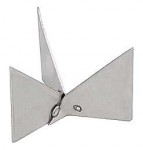 Y'all can utilise enameling stilts as drying racks. Coat i side permit set, and then coat the other side, the side by side day. Ensure that the product doesn't drip over to the behind – clean that stuff upwards, immediately!
I have two pages that relate to finishing for your edification:Q&A: Finishing and my primary Finishing page (links are to issues specific to your questions). Hopefully, these pages will help.
Equally to your problem with clogged holes, can y'all but drill them out (with a new, abrupt bit) later on finishing (and the coating has setup for at least 24 hours) so put in the wires? I don't come across a lot of other choices as the stuff does like to coat and cling. Maybe you lot could put wax plugs in the holes, spray or coat with the sealant, permit the cease gear up and then place the pieces on a warm hot plate or in a toaster oven (on can foil to catch the melted wax) to cook the wax? You might fifty-fifty be able to merely pop them out with a scribe or other slender object. I'd cheque them often and definitely experiment first!
 You can purchase wax wire in many gauges. Many jewelry suppliers carry wax wire in different gauges. Either purchase a range of gauges, like in the link in a higher place or purchase a unmarried gauge. Match the gauge of your drill bit, that fabricated the hole in the get-go place, with the gauge of the wire. I don't know if this is a stupid idea or not. I hope you'll let me know!
I am thinking that some type of resist volition work. I would experiment with flake first! Well, that'due south all I've got. Sorry.
The joy and frustration of being a jeweler are encountering insolvable bug and working out solutions. If a problem bothers usa enough, we'll effigy out a fashion around, through or over the result.
Back to Tabular array of Contents
What compounds should I utilize?
Question
You said in the video that you use carmine rouge fifty-fifty though yous're supposed to use white. I have merely dark-green rouge and platinum white. Would they be sufficient for polishing and finishing my gold jewelry? Besides, my rings have scratched that I'm trying to go rid of and then I was wondering which rouge should I utilize Beginning to get the scratches out? I'm guessing Brown Tripoli?? (Although I currently don't have it) I'm trying to make my rings look make new, scratch-free! 😀
Also, I have the Foredom flex shaft, the aforementioned equally yours, and I was likewise wondering what rotary accessories you lot would recommend for POLISHING and FINISHING jewelry.
Respond
I only use scarlet rouge. The pre-finish is, what I feel, is the most important. I sand with sandpaper or sanding discs from 320 dust up to at least 1200 grit – ofttimes college – and and then I utilise the rouge.
You can utilize a pre-polishing compound, like brown tripoli orbobbing compound starting time and then motion on to a final finish chemical compound similar jeweler's rouge.
At that place are so many types of compounds that do the same job, to the same metals merely, have different names. Information technology seems that every company comes upwards with its own special brand. I started getting besides dislocated and decided to just stick with the rouge. Information technology does the job for me.
Equally to your other polishing compounds, I would check with the manufacturer or read the characterization as to their uses. Determine whether your compound is: 1. Either an abrasive or a polishing chemical compound and ii. whether or not information technology is suited for the type of metal y'all are using. Test the compounds before using them on a final piece. See the chart in the burring and polishing compounds link beneath.
Be wary of mixing compounds on the same wheel or using quondam buffs and wheels equally abrasive compounds could be mixed together with polishing compounds. That can generate a lot of cleanup piece of work. I utilise one bicycle with one blazon of metal, with one compound. I keep the wheel and the compound, together, in their own plastic pocketbook. It makes it easier to call back what is what.
Another consideration: If you are pushing out 100 pieces and need a fast terminate – compounds, on a wheel or tumbling are much faster than hand sanding. And then, perhaps, compounds are what you need. You didn't mention how many pieces you were trying to stop.
If you are interested, hither'southward an article from Ganoksin on mass finishing. The article mainly deals with tumbling though so, maybe it'south not what you want.
I highly recommend the following article, written past John Fisher, called:Buffing and Polishing compounds.Information technology is very well done and explains so much. I found this article onGanoksin'southward site likewise. I think you volition larn a lot from this article!
Any yous do, – buy from a trusted supplier – as quality and grit will vary from blazon to blazon. I pretty much only utilize red rouge.

Muslin Buffs
I apply muslin and feltbuffs, generally, with my flex shaft. I like the loose weave of the muslin buffs (they are fluffier) for some jobs – usually, those with texture and a lot of nooks and crannies and I sometimes use a felt bike for smoothen surfaces or for removing scratches from stones (in tandem with diamond lap paste).
I also similarRadial Bristle Discs (for both the flex shaft) for textured and recessed surfaces. They also brand the bristle discs in larger sizes for the buffing wheel. They cost much more though!

Otto Frei Flexacrylic Polishing and Abrasive Wheels Kit
I use silicone points, knife-edged wheels, and other shapes for other types of finishing – similar getting into tough spots. Please see my techniques web pages for more than links!

Ottotech past EVE Silicone Polishing Kit of 90
I besides accept a buffing wheel that I use various wheel types on. I like a deburring cycle for general cleanup and pre-polishing.
On cleaning upward your scratches: it all depends on how deep they are. If they are very deep you might have to use files. But, I'd kickoff with sandpaper and move on to points, wheels, and discs. Finish with a vitrify and polishing compound.
I have a friend who only uses annoying wheels to finish her jewelry, some other who only uses the buffing wheel, another swears past tumbling. Whatsoever works for you!
I approximate my answer is: the job will dictate the tool!
How to finish edges and interior pierced areas.
Question
The edges and interior spaces, on my pierced earrings, look raw. What exercise I do to round them and make them look sexy like yours…lol?
Answer

You need to utilize files and sandpaper! I dear using escapement files for this process. Escapement files are very small files – smaller than needle files. They fit well into the small recesses created when piercing metal.
Sanding is also important – when the filing is finished.
I method for sanding in tiny areas is to utilize Mitchell'southward annoying cord or tapes. You lot can thread the tape or cord through tiny spots and really smoothen downward the interior surfaces.

Mitchell'south Annoying Cord and Tape
Another choice is to make yourself a sanding stick. You can make a larger sanding stick (instructions below) or wrap a toothpick with sandpaper. Sometimes I roll the sandpaper into a point to achieve those elusive areas. Lookout my two videos on sanding.

Sandpaper rolled into a fine-pointed cone for reaching minor areas.
Making a Sanding Stick
These sanding sticks are made using double stick newspaper, arts and crafts foam sheets, and craft sticks. You can also utilize paint stirrers. I cut mine in half to become two out of each stick. You tin as well brand the sticks without the foam. The foam helps to create rounded edges because the metal tin exist encompassed by the sandpaper simply, foam-less sanding sticks work well besides.
Sanding stick with foam
- Cut the tip off of the stick
- Measure out stick width and length.
- Cutting two strips of double-stick record or double-stick paper that are a bit thinner than the width of the stick.
- Apply double stick paper onto both sides of the sanding stick.
- Cut foam at double the width of stick plus, add together a handful of millimeters actress. Yous need to take into account the depth of the stick and add a little for the thickness of the cream.
- Wrap foam around the stick, having both edges meet in the center of the stick.
- Apply another layer of double stick paper, but to the back of the foam stick (where the seam is). Wrap sandpaper effectually the stick with edges meeting on the backside. Press downward into double stick tape.
Sanding stick without cream
- Cutting and shape equally in the instructions to a higher place. Employ double stick to 1 side of the stick. Apply the sanding paper and wrap it around the stick. Come across images.
 Materials: Double stick newspaper, sandpaper, arts and crafts stick & craft cream.
 Arts and crafts stick with the cease cut off and double stick practical.
 Foam stuck to a arts and crafts stick with double-stick applied to the dorsum, on top of the foam, to hold the sandpaper in place.
 Apply sandpaper to the back.
 The finished sanding stick.
- You tin also use prophylactic cement or other glue.
- Stay away from Elmer-type glue – too wet and too slow!
- Another idea is to use an elastic band on each end or only use masking or painter's tape.
- You tin also brand a sanding block from wood or a cream core.

For interior spaces, you can utilize Mitchell's abrasive cords or tapes. Tiny files, similar micro needle files or escapement files, will as well help.
 I frequently put these 3m sanding bandsinto my jeweler'south saw frame to sand tight areas. Y'all tin can as well put Mitchell's cords and tape into your saw frame.
Is Information technology Ok To Rub A Dark-green-Scrungy-Thingy On 14k Gold-Filled Sheet Metal To Get A Brushed Stop Or To Fine Steel Wool Information technology?
Question
"Is information technology ok to rub a green-scrubby-thingy on 14k gilt-filled sheet metal to become a brushed finish? Or to fine steel wool information technology? I live in the tropics and tarnish is an issue."
Here's a photo of what I'm trying to achieve: one is contumely, the other is the gold-fill. I don't want to sell anything that will tarnish hands, and I don't want to employ lacquer. I'grand trying to get away from using brass, and this piece is popular, and then I'd like to effort golden-filled."

Answer
You can apply the green scrubby thingy and steel wool (0000) on the metallic – all of it. Don't rub too hard. Hopefully, the gilt-filled is of good quality. There is some crappy stuff out there. Run across my folio on gold-filled for more information. The gilded may tarnish a scrap – non too much – not similar silver, brass, bronze, or copper. It tarnishes because it has copper in it. So, tarnish-free may only exist a dream…I don't recommend sealers, like Protecta Clear – Everbrite, unless it is used on earrings or necklaces. On other types of jewelry i.e.: rings and bracelets, the wear is too slap-up. Tarnish can be beautiful – learn to appreciate and stand behind it!
How do you put a scratched ("ice") stop on metal jewelry?
Question


Answer
There are many different types of tools that can requite that scratched (or, as this visitor calls it: Ice) cease. Even something as unproblematic as the edge of a foursquare file can exercise information technology. Apply the file like you would if you were shading with a pencil. There are checkering filestoo that requite a nice texture.
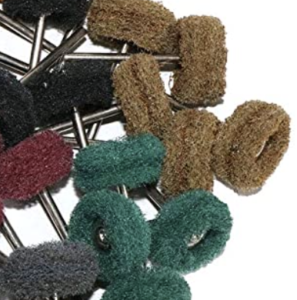
Polishing pads "scrubby wheels"
In that location are wheel brushes too like this cable twist wire bicycle – wear gloves! Not for the flex shaft. Y'all could try a really rough mini-fiber wheel. Another option is a Mizzi Wheel. You demand a mandrel to mount them just, you tin use them in the flex shaft. You lot could as well endeavor really rough sandpaper, like lxxx or 100 grit.
You could likewise use an angle grinder with a rough dust.

Sanding bands, barrels, or drums.
Sanding bands or barrels could be another option. They come in a variety of sizes.
George Goehl has a lot of information on 5 imeo well-nigh finishing metal. Y'all might take to rent one for 3.00 but he presents some ideas in the trailer. I know his youtube video talks most a lot of tools for texturing. He is a sculptor simply, the techniques will work for jewelers too.
The big rule here is to examination on sample metal showtime! Back to Table of Contents
Can I Silverish Plate Nickel?
Question
"Is there a way to add a low-cal coat of silver on top kind of similar a plating?"
Reply
Yous tin have information technology plated or learn to do it yourself. I only use a plating pen and just infrequently. In that location are places that y'all can send your work out to just, I don't know of whatever offhand. Nickel tin be plated.Dorsum to Tabular array of Contents
How Do I Texture My Metal To Friction match This Pattern (Looks Similar Reticulation or A Sandpaper Terminate)
Question
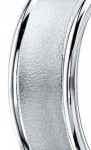 "I've looked all over, and have yet to notice an answer. And this may be out of your expertise only I'k looking to detect out how to make the finish seen here, on this ring by La Masters of Fine Jewelry.
Some call information technology a wire-brushed finish not to be confused with the common brushed finish.
I'1000 thinking it may be a specialty rolled impression. Have yous seen it before and know how it's done?"
Answer
Information technology looks a bit like reticulation. It could as well be an embossed design. I'd make a texture hammer, texture your metallic and use the dorsum side. Maybe texture on wood and then that the underside keeps its shape. You lot could also endeavour running a piece of 180 grit sandpaper in a rolling mill with the metal. Protect your mill by either making a thick newspaper sandwich (like watercolor paper) or a contumely sandwich around the metal and the sandpaper.
Chances are, that it's a machined cease that is proprietary. Simply, you lot tin can experiment and find something close.
The finish is probably brushed – subsequently the texturing is done. Have yous seen my Questions and Answers folio: Finishing Questions? I besides have another page on Finishing. Here'southward the link to the specific data that you need:Brushed or Textured Cease.Dorsum to Tabular array of Contents
How to Create a White, Matte, or Satin ("Water ice") Finish on Silver
Question
"How do I create the finish below? Is it a chemical thing?"

Answer
Without actually seeing the jewelry – personally – I tin can just approximate. It looks like depletion gilding (some call it "Brilliant Dipping" where the fine silverish is brought to the surface of the silver. The metal is heated, pickled, heated, pickled, etc. up to 7-10 times. The trouble with this technique is that the layer of white, fine silvery, is very sparse and easily worn or scratched without some sort of protective blanket. It also could be a sandblasted finish and and so depletion aureate. Maybe it is etched and and then depletion gilded. Fine and sterling silvers, PMC, or silvery metal clay, volition all have this white layer after firing or torching then pickling.
Sandblasting will likewise create this type of effect. A pocket-size, portable system may work. Only, you need a compressor too. Match the sandblasting system's needs to determine the right compressor to use with information technology. Check to see what PSI the equalizer requires before purchasing a compressor.
You lot can too try Mizzy Heatless Wheels , d eburring wheel, or tumbling/polishing media. Some utilize steel wool or SOS Pads or something similar. You tin can too apply 3M's Scotch-Brite Pads.

3M Scotch Brite Pads
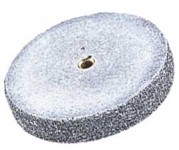
Mizzy Heatless Cycle
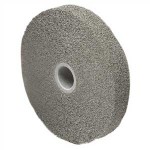
Deburring Bicycle

Tumbling Media.
More Data
-
- Dawn Z ., Hodgepodgerie, What shot can exist used to get a matte, wearisome, shine on silverish discs? New York. 2010. Web.
- How to Finish Jewelry
- How to Sand
- Finishing Jewelry
- Firescale and Oxidation
- Sanding
- Texturing Metals
- Come across Q & A Tools –What Dremel Attachments Do I Demand?
- See Q & A Finishing – How To Remove Dross/Slag From Laser Cutting?

Source: https://nancylthamilton.com/questions-and-answers/finishing-questions/
Posted by: bernercamed1952.blogspot.com
0 Response to "How To Clean And Seal Small Cones For Jewelry"
Post a Comment